


As a supplier of 600mm Indoor WPC (Wood-Plastic Composite) Boards, I often receive inquiries about the recyclability of our products. This is a crucial topic in today's environmentally - conscious market, where sustainability is a key concern for both businesses and consumers. In this blog, I will delve into the question: Can 600mm Indoor WPC Board be recycled?
Understanding 600mm Indoor WPC Board
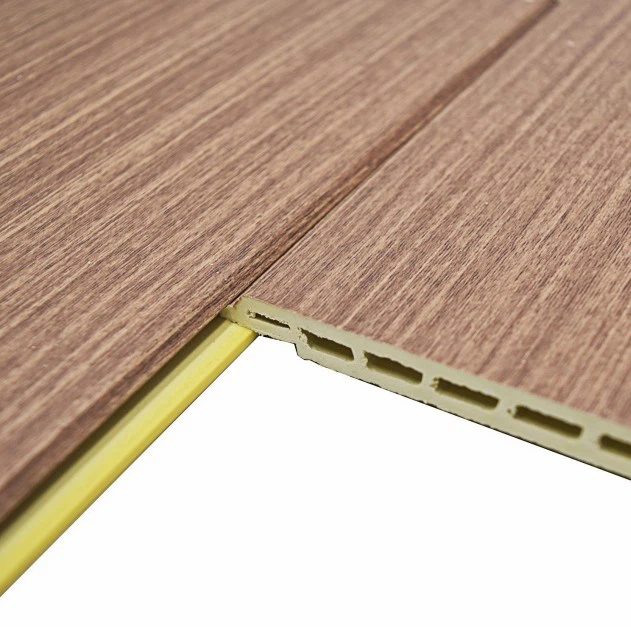
First, let's briefly understand what a 600mm Indoor WPC Board is. 600mm Indoor WPC Board is a type of composite material that combines wood fibers or flour with thermoplastics. The 600mm refers to the width of the board, which is a popular size for indoor applications such as wall cladding, ceiling panels, and interior partitions.
The combination of wood and plastic in WPC boards offers several advantages. It has the natural look and feel of wood, while also being more durable and resistant to moisture, rot, and pests compared to traditional wood products. These features make it an ideal choice for indoor use, especially in areas with high humidity or where maintenance is a concern.
The Composition of WPC Boards and Its Impact on Recyclability
To determine whether 600mm Indoor WPC Boards can be recycled, we need to look at their composition. As mentioned earlier, WPC boards are made up of wood fibers and thermoplastics. The thermoplastics commonly used in WPC production include polyethylene (PE), polypropylene (PP), and polyvinyl chloride (PVC).
Wood fibers, being a natural and biodegradable material, can theoretically be broken down and reused in various ways. However, the presence of thermoplastics complicates the recycling process. Thermoplastics can be melted and re - formed into new products, but the combination with wood fibers makes it more challenging.
The bonding between the wood fibers and the thermoplastics in WPC boards is designed to be strong and durable. This means that separating the two components for recycling is not straightforward. Additionally, the presence of additives such as colorants, stabilizers, and lubricants in the WPC boards further complicates the recycling process. These additives can affect the quality and properties of the recycled material.
Current Recycling Methods for WPC Boards
Despite the challenges, there are some methods available for recycling 600mm Indoor WPC Boards. One approach is mechanical recycling. In mechanical recycling, the WPC boards are first shredded into small pieces. Then, the shredded material is heated to melt the thermoplastics, allowing for the re - formation of new products. However, this method has its limitations. The recycled material may have reduced mechanical properties compared to the original WPC board, and the presence of wood fibers can cause issues during the melting and re - forming process.
Another method is chemical recycling. Chemical recycling involves breaking down the polymers in the thermoplastics into their basic monomers. These monomers can then be used to produce new plastics. However, chemical recycling is still in the early stages of development for WPC boards, and it is currently more expensive and complex than mechanical recycling.
Factors Affecting the Recyclability of 600mm Indoor WPC Boards
Several factors can affect the recyclability of 600mm Indoor WPC Boards. One of the main factors is the purity of the material. If the WPC boards are contaminated with other materials such as dirt, paint, or metal, it can significantly reduce their recyclability. Therefore, proper sorting and cleaning of the WPC boards before recycling are essential.
The age and condition of the WPC boards also play a role. Over time, the wood fibers in the WPC boards may degrade, and the thermoplastics may become brittle. This can affect the quality of the recycled material. Additionally, the manufacturing process of the WPC boards can influence their recyclability. Boards that are made with more uniform composition and fewer additives are generally easier to recycle.
The Future of WPC Board Recycling
The future of 600mm Indoor WPC Board recycling looks promising. As the demand for sustainable building materials continues to grow, there is increasing research and development in the field of WPC board recycling. Scientists and engineers are working on developing more efficient and cost - effective recycling methods.
One potential solution is the development of new WPC formulations that are easier to recycle. For example, using more compatible polymers and wood fibers or reducing the use of additives can simplify the recycling process. Additionally, advancements in separation technologies may make it easier to separate the wood fibers and thermoplastics in WPC boards.
Comparison with Other Indoor Board Options
When considering the recyclability of 600mm Indoor WPC Boards, it is useful to compare them with other indoor board options. For instance, 400mm Indoor WPC Board has similar composition and recyclability challenges as the 600mm boards. However, the size difference may not have a significant impact on the recycling process.
Traditional wood boards are generally more easily biodegradable, but they may require more maintenance and are less durable in certain indoor environments. On the other hand, pure plastic boards are easier to recycle in theory, but they lack the natural aesthetic of wood.
Our Commitment as a Supplier
As a supplier of 600mm Indoor WPC Boards, we are committed to promoting sustainability in our industry. We are actively involved in research and development to improve the recyclability of our products. We work closely with recycling facilities to ensure that our WPC boards are recycled in the most efficient and environmentally friendly way possible.
We also educate our customers about the importance of proper disposal and recycling of our products. By providing clear instructions on how to handle end - of - life WPC boards, we hope to increase the recycling rate and reduce the environmental impact of our products.

Conclusion
In conclusion, while the recyclability of 600mm Indoor WPC Boards is a complex issue, it is not impossible. The combination of wood fibers and thermoplastics in WPC boards presents challenges, but with the right methods and technologies, recycling can be achieved. As the industry continues to evolve, we can expect to see improvements in the recycling process for WPC boards.
If you are interested in purchasing 600mm Indoor WPC Boards or have any questions about their recyclability, please feel free to contact us. We are more than happy to assist you in making an informed decision and to discuss how our products can meet your indoor design and sustainability needs.
References
- "Wood - Plastic Composites: Materials, Processing, and Applications" by Sabu Thomas, Laly A. Pothan, and Sabu Jacob.
- Research papers on WPC board recycling from scientific journals such as "Composites Part A: Applied Science and Manufacturing" and "Journal of Cleaner Production".


